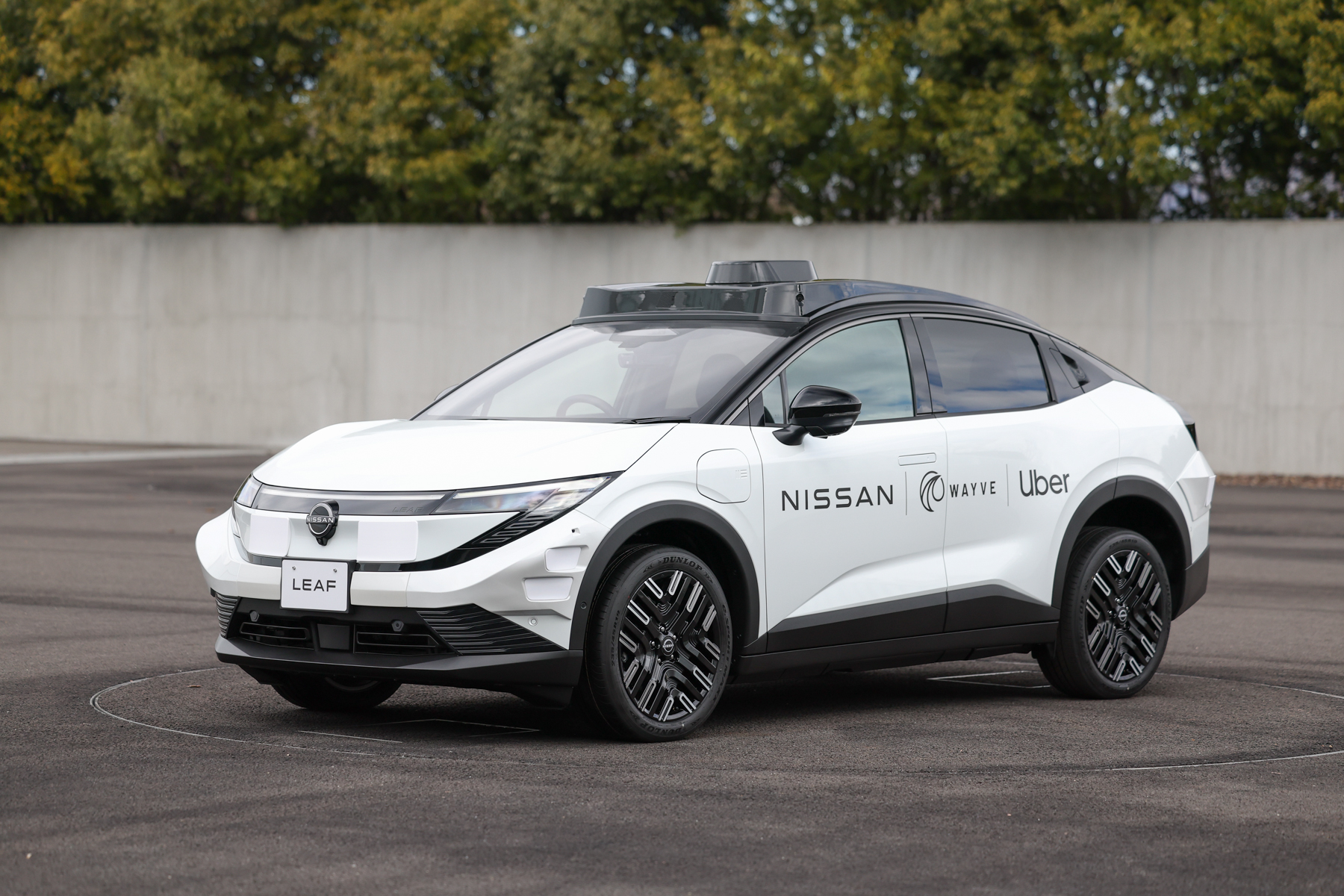
Wayve, Uber and Nissan are launching a robotaxi service in Tokyo by late 2026. The three companies signed a memorandum of understanding on March 11, 2026. Wayve provides the AI driving software, Nissan supplies the vehicle and Uber handles rider distribution through its app. It is Uber’s first autonomous vehicle partnership in Japan, and part of a planned rollout across more than ten cities worldwide including London. For Nissan, currently navigating a major financial restructuring, the deal avoids the need for costly in-house development.
What each company brings to the table
The partnership has a clear structure. Wayve provides the autonomous driving technology: its AI Driver system, built to adapt to new roads and cities purely from real-world data, with no reliance on pre-built HD maps. That system will be integrated into a Nissan LEAF, which will then be made available to riders through the Uber app.
Uber, for its part, brings the distribution network. It intends to launch the service through a licensed Japanese taxi partner that is currently in the process of being selected, coordinating with the relevant regulatory authorities. The same asset-light model it has used to accumulate autonomous vehicle partnerships across the US, UK, Europe, East Asia and the MENA region.
During the initial phase, a trained safety operator will be present in every vehicle. This will allow riders to experience the service as part of their everyday journeys before any transition toward fully driverless operations.
Tokyo as a proving ground
The companies are not picking an easy market to start with. Tokyo is widely recognised as one of the world’s most challenging urban driving environments: notorious for its traffic density, intricate road network, and exceptionally high safety standards. Wayve CEO Alex Kendall described it as “one of the world’s most sophisticated mobility markets,” noting that the company has been testing its technology throughout Japan since early 2025, building experience on the country’s unique road environments.
That local testing history matters. Wayve’s argument, that its AI can generalise across new environments without city-specific HD maps, only holds up if it can demonstrate reliable performance in demanding conditions. Tokyo is about as demanding as it gets.
Part of a much larger rollout
This announcement is one piece of a broader expansion strategy. Wayve and Uber have committed to deploying robotaxi services across more than ten cities worldwide, including London. Uber CEO Dara Khosrowshahi framed Japan specifically as a critical market. He noted that innovation can help address driver shortages and support the future of urban transportation.
Wayve, meanwhile, raised $1.2 billion in a funding round that included Uber and Nissan among its investors. Other backers were SoftBank, Nvidia, Microsoft, Mercedes-Benz, and Stellantis. The breadth of that investor list, from automakers like Nissan and Mercedes-Benz to tech giants like Nvidia and Microsoft, reflects how broadly Wayve’s approach resonates across the industry
What this means for Nissan
For Nissan, the stakes are particularly high. The automaker is navigating a dramatic restructuring, projecting a net loss of approximately $4 billion for the current fiscal year. Having lost ground on hybrids and watched Chinese rivals erode its early EV advantage, partnering with Wayve rather than developing in-house autonomous technology is a deliberate strategic choice.
The choice of the Nissan LEAF is also a statement. It shows that a mass-market production vehicle can serve as the base for a fully autonomous service. Its next-generation ProPilot driver assistance systems are planned for launch in fiscal year 2027, and Wayve’s technology is expected to power them.
A city, a partnership, and a broader shift
What this announcement reflects, beyond the specifics, is how the autonomous vehicle industry is actually scaling. Not through one dominant player building everything end to end, but through focused partnerships: an AI company that doesn’t build cars, an automaker that doesn’t build software, and a platform that connects riders to whichever technology is ready to move them. Tokyo is the next city on that list, and probably one of the hardest.
For more information about robotaxi : click here !
Sources :
https://www.automotiveworld.com/news/nissan-uber-and-wayve-join-forces-for-tokyo-robotaxi-pilot/