
For years, Europe has been seen as moving more cautiously than other regions in the development of autonomous ride-hailing services. While robotaxis have already become part of the urban mobility landscape in parts of the United States and China, Europe has spent much of the past decade focusing on pilot programs, regulatory frameworks and electrification.
That dynamic may now be changing. A series of announcements, partnerships and early deployments suggest that robotaxis are beginning to enter Europe’s mobility ecosystem. The shift will likely be gradual, but the momentum is becoming increasingly difficult to ignore.
The global robotaxi boom
Around the world, robotaxis are moving from experimental projects to real services. In the United States, companies such as Waymo have already launched commercial autonomous ride-hailing operations in several cities. In China, firms like Baidu and Pony.ai have deployed large robotaxi fleets operating across multiple urban areas.
These services demonstrate how autonomous vehicles could transform urban transport by reducing reliance on human drivers in ride-hailing fleets. The model promises lower operating costs, increased vehicle utilization and potentially safer road networks.
As a result, the race to deploy robotaxis has intensified. Technology companies, automakers and mobility platforms are competing to build the infrastructure and partnerships needed to scale autonomous ride-hailing globally.
Until recently, however, Europe had largely remained outside that race.
Europe’s first robotaxi service
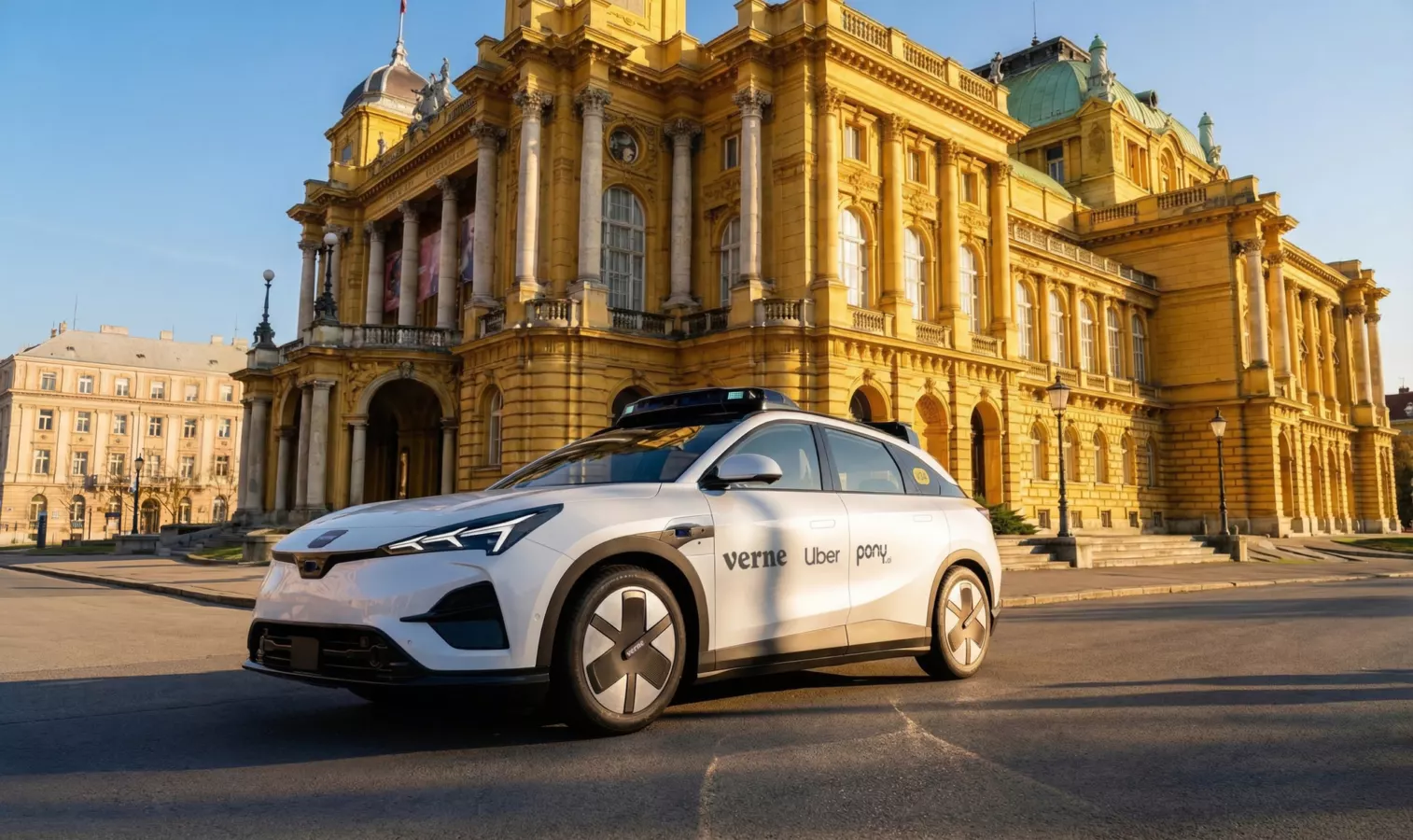
One of the most notable developments in autonomous mobility came with the launch of what is being described as Europe’s first commercial robotaxi service in Croatia. Autonomous driving company Pony.ai introduced the service in Zagreb through a partnership with Croatian mobility operator Verne and ride-hailing platform Uber, marking a milestone for the continent’s autonomous transport ambitions.
The launch signals a shift from pure testing toward operational services. Although safety supervision is still part of the early rollout, the project represents a concrete step toward integrating autonomous ride-hailing into European cities.
For Europe’s mobility sector, the significance lies less in the scale of the launch than in the precedent it sets. After years of trials and regulatory preparation, robotaxis are no longer only a concept under evaluation in Europe. They are indeed beginning to operate in real urban environments.
Partnerships and the next phase of robotaxi deployment
The European robotaxi landscape is quickly filling with partnerships between autonomous technology developers and mobility platforms. Bolt, one of Europe’s largest mobility platforms, has announced a collaboration with Pony.ai to bring autonomous ride-hailing services to the continent. The partnership aims to integrate robotaxis directly into Bolt’s platform, allowing users to book autonomous rides through the same applications they already use for ride-hailing services.
Bolt has also announced collaborations involving NVIDIA’s autonomous driving technology and Stellantis, reflecting the growing ecosystem forming around autonomous mobility. Meanwhile, global ride-hailing platforms are positioning themselves for the robotaxi era. Uber has announced plans to launch Level-4 software-driven robotaxis across multiple cities, including some in Europe, in partnership with NVIDIA by 2028, highlighting how major mobility platforms are preparing to integrate autonomous vehicles into their networks once technology and regulation allow broader deployment.
Despite Europe’s slower start compared with the United States or China, the pace of robotaxi development on the continent now appears to be accelerating. London has emerged as a key hub for autonomous mobility development. Waymo is already conducting mapping and testing across several London boroughs ahead of a planned commercial robotaxi service expected later in 2026.
Other international players are also preparing to enter the European market through partnerships. Baidu’s Apollo Go robotaxi platform is pursuing expansion in Europe through a partnership with Lyft. They are targeting future deployments in cities such as Berlin and London.
Other cities are also likely to follow as regulatory frameworks mature and pilot programs demonstrate the safety and reliability of autonomous driving technologies. The broader trend is clear: autonomous mobility in Europe is gradually transitioning from pilot projects to the first operational services.
Why Europe has moved more slowly
Despite these developments, Europe’s progress in robotaxi deployment has been slower than in the United States or in China.
One major factor is regulation. European countries maintain strict safety standards and regulatory processes for autonomous vehicles, which often require extensive validation before commercial deployment is allowed. In contrast, some regions in the United States and China have provided more flexible frameworks that enable faster testing and scaling.
However, Germany was in fact the first country in the world to legislate for Level 4 autonomous driving on public roads, back in 2021, a reminder that Europe’s regulatory landscape is more nuanced than a simple story of caution.
Urban complexity also plays a role. European cities tend to have dense road networks, older infrastructure and complex traffic patterns that present unique challenges for autonomous driving systems.
Finally, Europe’s mobility strategy has historically focused heavily on electrification and public transport. While autonomous vehicles have been part of the discussion, they have not been the central focus of mobility policy in many countries.
The next phase of autonomous mobility
The arrival of robotaxis in Europe does not mean the continent will suddenly match the scale of deployments seen in the United States or China. Instead, Europe will likely follow a more measured approach, with city-by-city launches and tightly regulated pilot programs.
Yet the direction of travel is becoming increasingly clear. Partnerships between mobility platforms, technology companies and automakers are laying the groundwork for autonomous ride-hailing services that could become a new component of urban transport networks.
At the same time, autonomous mobility in Europe is not limited to robotaxis. Trials of self-driving public transport, including autonomous buses such as those tested by Karsan with the RATP Group in Paris, as well as innovations in other sectors like electric ferries developed by companies such as Candela, illustrate how automation is gradually spreading across different parts of the transport system.
For years, robotaxis were framed as a technology of the future. In Europe, that future is now beginning to take shape, gradually and across multiple forms of mobility.
For more articles : Click here !