The mobility sector is undergoing a rapid transformation driven by autonomy, electrification, connectivity and new transport modes. In April 2026, five major developments stood out: the acceleration of autonomous bus projects in the UK, the launch of Europe’s first robotaxi service, a breakthrough in electric long-haul trucking, the rise of autonomous vehicles as real-time data collection systems and continued progress in urban air mobility.
1. Pony.ai Brings Robotaxis to Europe with a First Deployment in Croatia
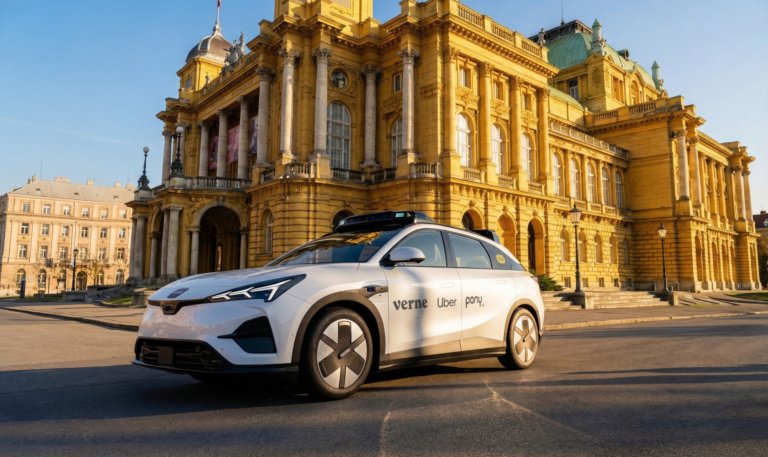
Autonomous ride-hailing has reached a significant milestone in Europe with the launch of a robotaxi service by Pony.ai in Zagreb. Developed in partnership with Uber and local operator Verne, the service represents the first commercial deployment of its kind on the continent.
The fleet operates in real-world conditions, marking a transition from controlled pilot programs to daily mobility services. While safety operators remain part of the system at this stage, the launch demonstrates increasing confidence in autonomous driving technologies and regulatory frameworks.
This move is particularly important in the European context, where regulatory fragmentation has historically slowed down deployment compared to the United States and China. By establishing a first operational model, the initiative could pave the way for similar partnerships between technology providers and mobility platforms across major European cities.
2. Volvo Trucks Pushes Electric Long-Haul Transport to 700 Kilometers
Volvo Trucks has introduced a new electric truck designed specifically for long-haul operations, with a range of up to 700 kilometers on a single charge. This represents a significant improvement over previous generations of heavy-duty electric vehicles.
The vehicle integrates a new e-axle architecture, enabling higher battery capacity without compromising cargo space. In addition, it is compatible with megawatt charging systems, allowing the battery to recharge from 20% to 80% in approximately 50 minutes. This aligns closely with regulated driver rest periods, making long-distance electric transport operationally viable.
The announcement addresses one of the main barriers to electrification in freight transport: range limitations. With this level of autonomy, electric trucks can now compete with diesel vehicles on long-distance routes, accelerating the decarbonization of logistics and supply chains.
3. Waymo Expands the Role of Autonomous Vehicles as Data Platforms
Autonomous vehicles are increasingly being positioned not only as transport solutions but also as sources of valuable infrastructure data. Waymo has launched a pilot program in collaboration with Waze to detect and report road hazards such as potholes.
Using onboard sensors including lidar, radar and cameras, Waymo’s robotaxis can identify road surface anomalies in real time. This information is then shared with Waze users and local authorities, enabling faster maintenance responses and improved road safety.
This initiative illustrates the emergence of a new layer in the mobility ecosystem: vehicles as distributed sensing networks. Beyond transporting passengers, autonomous fleets can continuously collect and process environmental data, creating additional value for cities and infrastructure operators.
4. Joby Aviation Demonstrates eVTOL Flights in New York
Urban air mobility continues to progress with the successful demonstration of electric vertical takeoff and landing flights by Joby Aviation in collaboration with the Port Authority of New York and New Jersey.
The flights connected JFK International Airport to several heliports in Manhattan, highlighting the potential to drastically reduce travel times in congested urban environments. These operations are part of a broader federal initiative aimed at accelerating the certification and deployment of air taxi services in the United States.
While regulatory approval and infrastructure development remain key challenges, these demonstrations provide a concrete example of how aerial mobility could complement existing transport systems. eVTOL aircraft are positioned as a zero-emission alternative for high-density corridors where ground congestion limits efficiency.
5. Wrightbus Advances Autonomous Public Transport in the UK
The UK government is reinforcing its commitment to autonomous mobility through new funding allocated to multiple pilot projects, including one led by Wrightbus. The initiative aims to explore how connected and automated mobility can address operational challenges in public transport systems.
Wrightbus will lead the industrial side of the project, leveraging its expertise in hydrogen and battery-electric buses. Academic partners Loughborough University and Queen’s University Belfast will focus on safety, human-machine interaction, and real-world deployment of autonomous systems.
This development reflects a broader shift in public transport policy. Rather than isolated trials, governments are now supporting structured experimentation to prepare for long-term integration. Autonomous buses could play a key role in mitigating driver shortages, reducing operating costs and improving accessibility in low-density or underserved areas.
Toward a Multi-Layered Mobility Ecosystem
The developments observed in April 2026 point toward a convergence of major technological trends in mobility. Autonomous systems are expanding across different use cases, from public transport to ride-hailing. Electrification is reaching new levels of performance, making it viable for long-haul freight. At the same time, vehicles are becoming data-generating platforms and entirely new transport layers such as urban air mobility are emerging.
Taken together, these changes suggest that the future of mobility will not be defined by a single innovation but by the integration of multiple systems. Ground, road and air transport are progressively merging into a connected ecosystem driven by automation, electrification, and real-time data.
For more articles : Click Here !