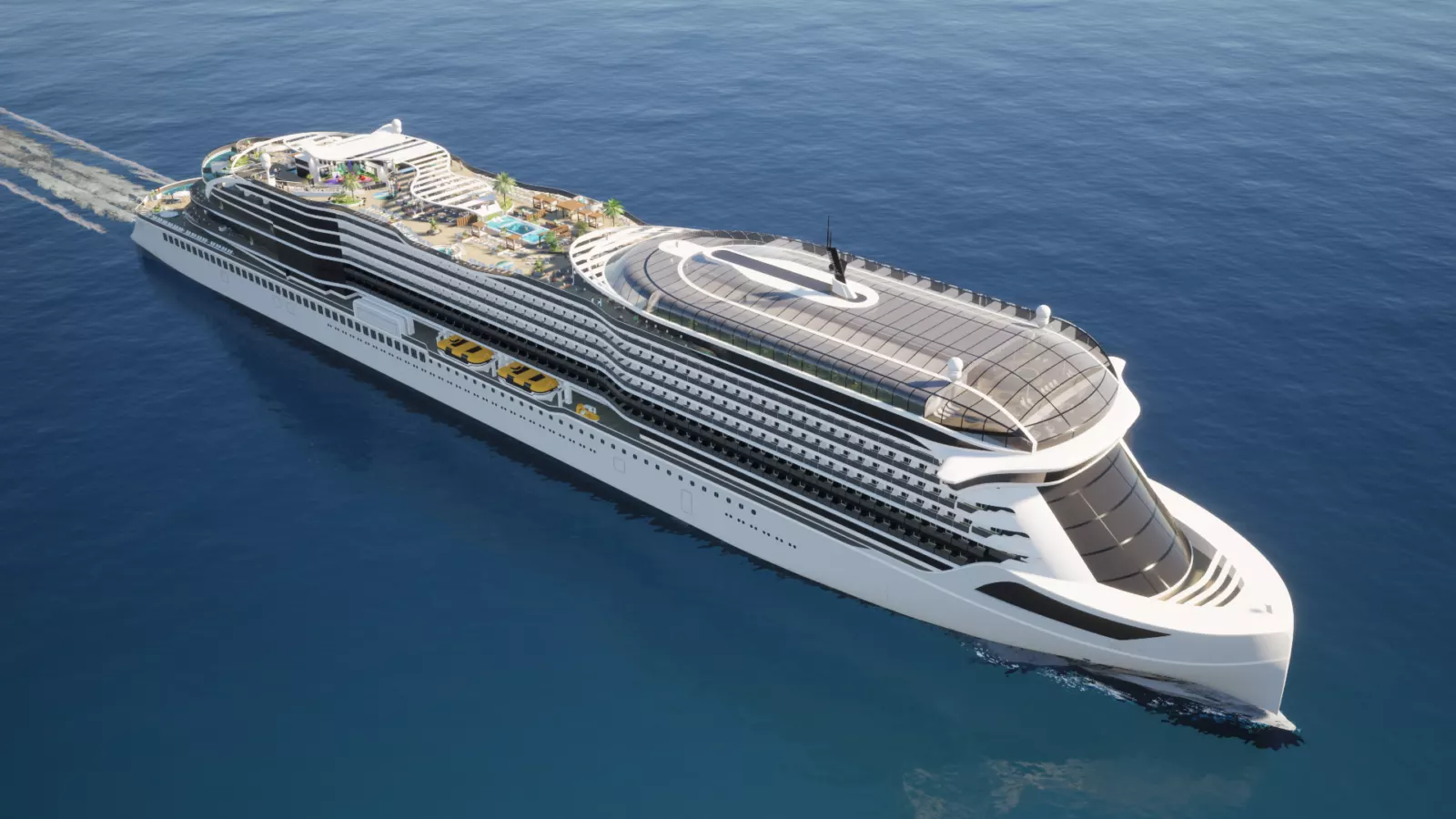
At this year’s Seatrade Cruise Global in Miami, German shipbuilder Meyer Werft introduced a concept that could redefine one of the most carbon-intensive segments of maritime transport: a fully battery-electric cruise ship at large scale.
The concept, called Project “Vision”, is designed to operate without conventional engines, potentially marking a turning point for an industry long criticized for its environmental footprint.
Scaling electrification to cruise ships
While electric ferries and short-range vessels have gained traction in recent years, scaling that technology to cruise ships has remained largely theoretical.
Meyer Werft’s concept pushes those boundaries with a ship measuring around 275 meters and exceeding 80,000 gross tons. It is capable of accommodating up to 1,856 passengers. That puts it in the same category as conventional mid-to-large cruise ships, rather than experimental prototypes.
The vessel would rely entirely on battery-electric propulsion, eliminating onboard fossil fuel combustion and reducing greenhouse gas emissions by up to 95% compared to traditional cruise ships.
Unlike smaller hybrid or alternative-fuel vessels currently in development, this concept is notable for its battery-first architecture, signaling confidence that maritime electrification can scale beyond niche use cases.
Built on existing technology, just bigger
One of the most striking aspects of Project “Vision” is that it doesn’t depend on breakthrough science. Instead, it scales up technologies already in operation.
The ship would use battery systems supplied by Norwegian specialist Corvus Energy. Their solutions already power a large share of hybrid and electric vessels globally.
According to Meyer Werft, the concept is not decades away. If ordered soon, the first vessel could be delivered by 2031.
That timeline reflects a broader shift across maritime transport: electrification is no longer a distant ambition, but an engineering and infrastructure challenge.
Rethinking cruise ship design
Going fully electric doesn’t just change propulsion, it reshapes ship architecture.
Without exhaust systems or large engine rooms, Project “Vision” introduces new design freedoms. For example, the absence of funnels allows for fully open deck spaces, improving passenger experience and aesthetics. At the same time, reduced noise and vibration from electric propulsion could significantly enhance onboard comfort.
The concept also reflects a shift toward all-season usability. Indeed, features like enclosed leisure areas that make the ship less dependent on climate conditions are planned.
Infrastructure becomes the next bottleneck
If the ship itself is feasible, the real challenge lies onshore.
Battery-electric cruise ships require high-capacity charging infrastructure at ports, something that is still in its infancy. However, the outlook is improving. Indeed, around one hundred ports across Europe will offer the required charging infrastructure by the end of the decade.
The concept is therefore optimized for regional routes, such as Mediterranean itineraries, where ships can recharge regularly between stops.
For longer journeys, Meyer Werft leaves the door open to hybrid configurations, highlighting a pragmatic approach to early deployment.
A turning point for cruise decarbonization?
Cruise ships are among the most energy-intensive vessels at sea, often running engines continuously,even while docked, to power onboard amenities.
By eliminating direct emissions during operation, the project addresses both climate impact and local air pollution, a growing concern in port cities.
More broadly, it signals a shift in how the industry approaches sustainability. Rather than incremental efficiency gains, shipbuilders are beginning to explore full system redesigns centered on electrification.
Whether Project “Vision” becomes a commercial reality remains to be seen. But as battery technology improves and port infrastructure catches up, the idea of zero-emission cruising is moving from concept to credible roadmap.
And if it succeeds, it could do for cruise ships what electric propulsion is already doing for ferries and short-sea shipping: quietly, but fundamentally, changing the rules of the game.
For more articles : Click here !