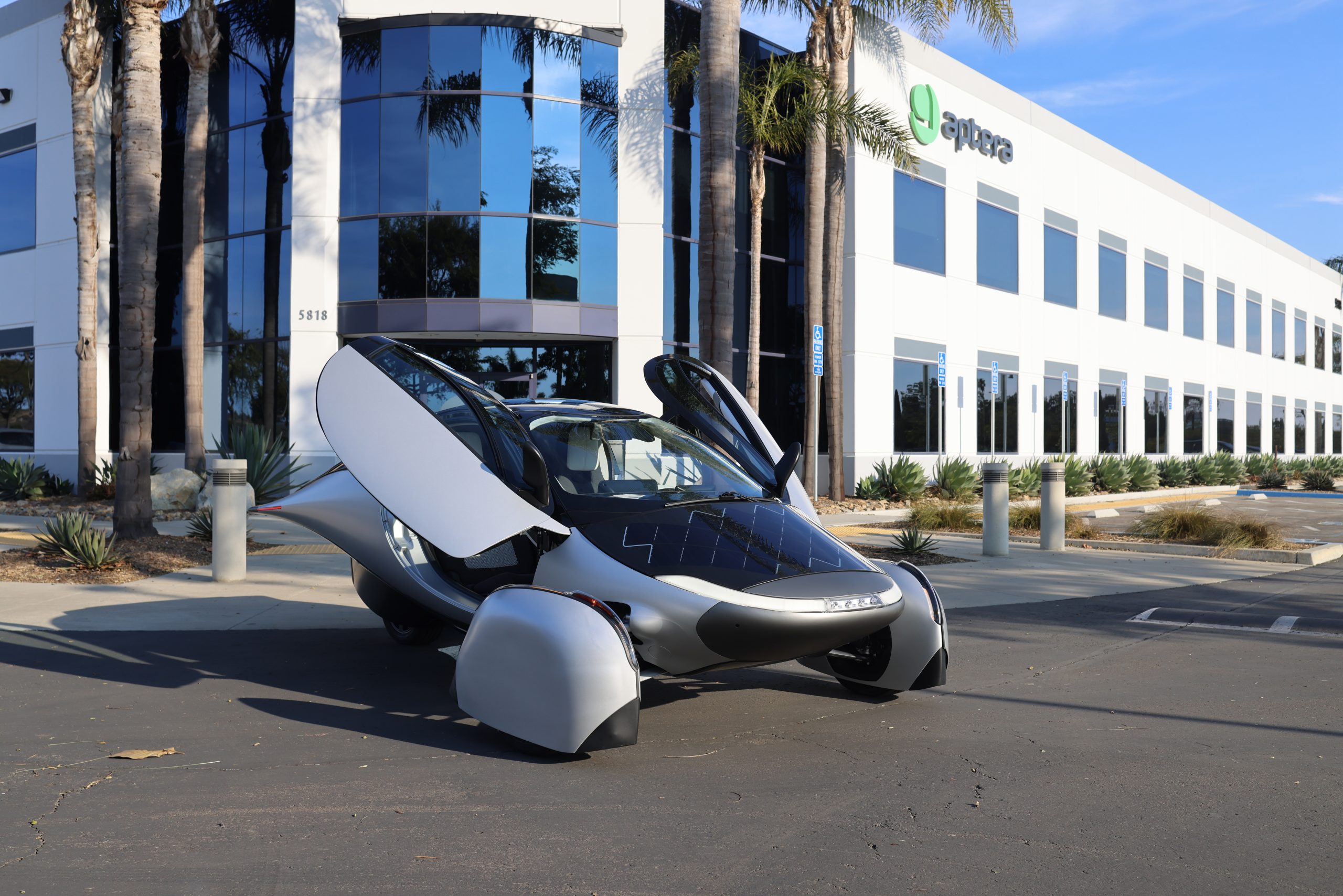
Solar EV startup Aptera Motors Corp. (NASDAQ: SEV) announced on March 3, 2026 that it has completed the first vehicle off its validation assembly line, a low-volume facility based at the company’s headquarters in Carlsbad, California. For a startup that has spent years navigating funding challenges and development cycles, that shift is more significant than it sounds.
What a validation assembly line actually means
The terminology is worth unpacking. A validation assembly line is not a full-scale production facility. Instead, its purpose is to produce vehicles consistently enough that engineers can test them, identify failures, refine procedures, and ultimately satisfy the requirements of regulatory certification bodies before committing to higher volume output.
Aptera’s validation line consists of 14 dedicated stations, each responsible for a specific phase of assembly. A team of vehicle line technicians works through a defined sequence, building the company’s three-wheeled solar EV in a manner that is repeatable from one unit to the next. That repeatability is precisely what makes the line valuable. In other words, it transforms vehicle production from an artisanal exercise into something engineers can measure, optimize, and eventually scale.
Testing programs and the road to certification
The team will allocate vehicles produced on the validation line to a set of structured testing programs. These include thermal validation, brake performance, and destructive testing. This kind of rigorous evaluation is what regulators and certification standards require before the manufacturer can commercially sell a vehicle.
The end goal of these efforts is EPA certification, a prerequisite for Aptera to legally deliver any vehicle to customers in the United States. Aptera has stated that its target remains delivering vehicles to customers in 2026. However, the company will require additional funding rounds to transition from validation-scale builds to full production volumes.
A team built around manufacturing
Aptera’s workforce has reorganized around this new phase. The assembly and integration team is now the company’s largest. This structural shift reflects how much the startup’s priorities have changed. On the line itself, each build is treated as an opportunity to improve. The team tweaks how systems are installed, rethinks station layouts, and tightens sequences that will eventually feed into a higher-volume facility.
It is the kind of work that is hard to fake. A growing assembly team, a functioning line, vehicles moving through defined stations – these are operational realities that either exist or they don’t. For a company that has spent years being judged on its promises, that grounding in physical execution may be the most important signal of all.
Financial context and demand signals
The validation line milestone follows a $9 million public equity raise completed in late January 2026, led by institutional investors. Aptera’s co-CEO Chris Anthony described the fundraise as deliberate in its structure. If all associated warrants are converted, total gross proceeds from the offering could reach $18 million. The company has directed those funds toward validation builds and production readiness.
On the demand side, Aptera currently holds nearly 50,000 vehicle reservations, representing over $2 billion in potential revenue. Those figures are contingent on the company successfully delivering a vehicle to market. This is a task that remains ahead of it but now appears more operationally grounded than at any previous point in its history.
A long road, with a clearer next step
Aptera’s story is not a straightforward one. The company was first founded in 2006 and shut down in 2011 without a single vehicle reaching mass production. Then a second company launched in 2012 but produced no vehicles. Finally, Aptera Motors Corp was relaunched in 2019 by its original founders, carrying with it the same vision and a new set of promises. Since then, delivery timelines have shifted repeatedly. What was once planned for 2021 has gradually moved toward 2026.
Through all of that, the three-wheeled, solar-integrated EV with an aerodynamic profile unlike anything else on the road has held the attention of a remarkably loyal community. Nearly 50,000 reservations are a testament to that.
The completion of the first vehicle off a structured assembly line does not resolve the challenges that remain. But it does represent something concrete and verifiable. A process is now in place, a team is assembled around it and vehicles are beginning to move through it. In the competitive and capital-intensive world of EV startups, that kind of operational foundation is not a given. For Aptera, it marks the beginning of a new chapter.
For more articles : Click Here !
Sources :
https://aptera.us/first-vehicle-off-validation-line/
https://electrek.co/2026/03/03/aptera-sev-completes-first-solar-ev-build-validation-assembly-line/