
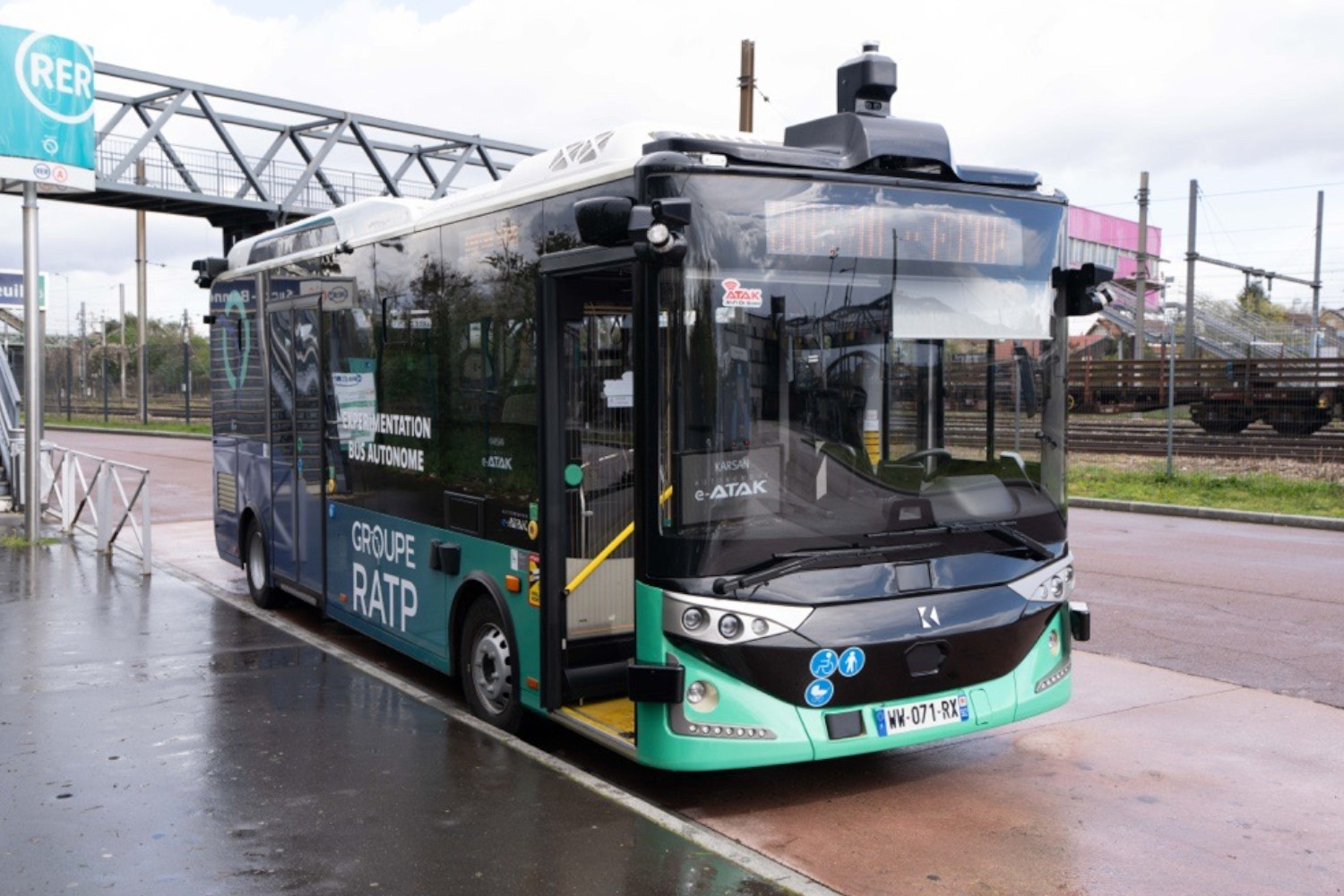
Autonomous buses have been promised for years. Most have proven themselves in controlled environments: closed campuses, airport loops, dedicated lanes. Karsan’s Autonomous e-ATAK just did something different. After six months of daily operation on a busy Paris bus corridor, the vehicle received authorization from the French Ministry of Transport to operate autonomously in open traffic across France. Not a pilot exemption. Not a controlled corridor. A nationwide authorization, earned through real-world performance in a city that does not hand out regulatory approval lightly.
What happened and why Paris matters
The Turkish mobility manufacturer Karsan partnered with RATP Group, the public transport operator that runs Paris’s buses, metro and RER network, for a six-month operational project concluding in April 2026. The test vehicle, the Autonomous e-ATAK, covered approximately 3,000 kilometers of autonomous driving under real urban conditions, with an average of five hours of daily operation.
The chosen route was not a quiet suburban loop. Operations took place on the approximately 8.5-kilometer central section of Bus Route 393, connecting Sucy-Bonneuil RER to Thiais-Carrefour de la Résistance. This is one of Paris’s busiest and most demanding corridors, involving mixed traffic, pedestrian crossings, signalized intersections and precise stopping at bus stops. Choosing this route rather than a quieter test environment was a deliberate signal: the technology is being validated where it actually needs to work.
The approval process and what it means
Before receiving operational clearance, the Autonomous e-ATAK underwent comprehensive technical validation at the UTAC test track, one of France’s leading automotive certification facilities. Based on those results, the vehicle was then granted nationwide testing approval by the DGEC, the body within the French Ministry of Transport responsible for autonomous mobility authorization. That approval gives Karsan the right to operate autonomously in open traffic across France, not just within a designated pilot zone.
France’s regulatory environment for autonomous vehicles is notably rigorous. Obtaining this approval in that context is not a formality; it is the outcome of a structured, multi-stage certification process.
The numbers behind the claim
The headline figure from the six-month pilot program is a 98% success rate in autonomous driving without driver intervention. That metric is worth unpacking. It does not mean the vehicle operated without a safety driver present, French regulations currently require one. What it reflects is how often the system completed its driving tasks without that driver needing to take over. Over thousands of kilometers and hundreds of operating hours in dense urban traffic, that rate represents the kind of consistency regulators and operators look for before committing to wider deployment.
The scenarios tested were not simple. The vehicle had to navigate mixed traffic conditions, respond in real time to traffic signals and intersections and stop with precision at bus stops, tasks that are elementary for a human driver but technically demanding for an autonomous system operating in an uncontrolled environment.
The technology stack behind the vehicle
The Autonomous e-ATAK is built on Karsan’s electric midibus platform, integrated with Level-4 autonomous driving software developed by ADASTEC. Level-4 means the vehicle is capable of handling all driving tasks within a defined operational domain, without requiring human intervention in normal conditions. It is one step below full autonomy, the system still has a defined scope, but it is the level at which commercially viable autonomous public transport becomes realistic.
ADASTEC CEO Dr. Ali Peker described the significance of the Paris validation in terms of scalability: operating successfully on a high-capacity BRT-style route in one of Europe’s most complex metropolitan environments demonstrates that the technology can be adapted to varied real-world conditions, not just purpose-built facilities.
What comes next
Karsan CEO Okan Baş has stated that the company’s target for 2026 is to go a step further: removing the safety driver from the system entirely. They plan to launch the next phase in Stavanger, Norway. Karsan intends to use a fully driverless operational model.
That ambition is not unusual in the autonomous vehicle sector. However, Paris validation provides a more credible foundation for it than most. Regulatory approval in France, earned through real-world testing rather than closed-course performance, is a transferable credential. It demonstrates that the system can satisfy the scrutiny of one of Europe’s more demanding transport authorities. It is precisely the kind of proof that other cities and operators need before committing to their own deployments.
A milestone in context
Autonomous public transport has been generating headlines for over a decade. Shuttles, pods and minibuses have operated in airports, campuses and controlled urban zones. What has remained elusive is validation in genuinely complex environments: dense city traffic, unpredictable pedestrian behavior, real-world infrastructure. The Paris project does not resolve every open question in autonomous mobility, but it closes one that matters. A Level-4 autonomous bus has now completed six months of real-world testing on a busy Paris corridor. It passed formal certification and received national approval. That is not a prototype result. It is an operational one.
For more articles : Click Here !
Source : Karsan