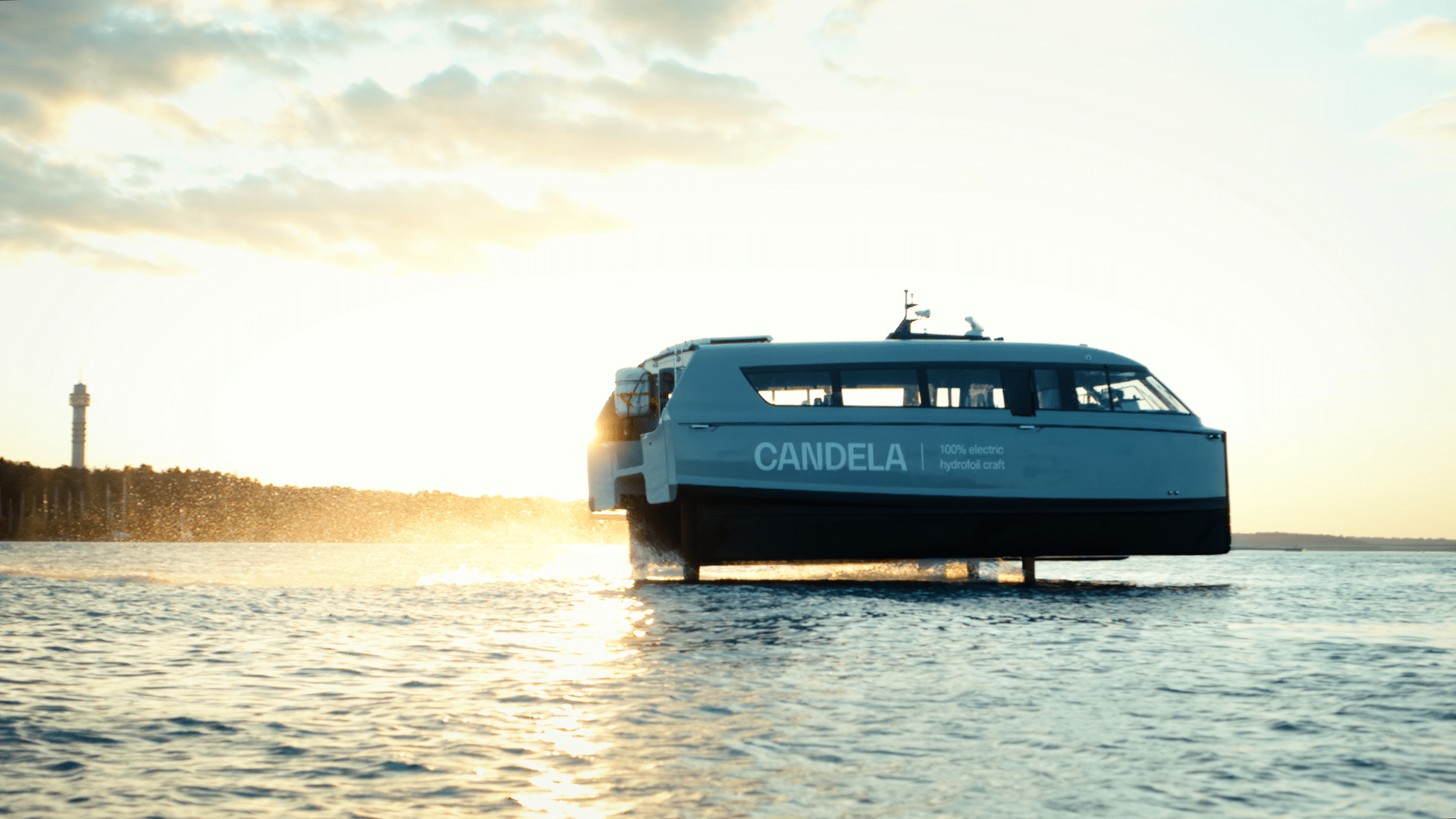
Candela and Canopy Power are developing a fully solar-powered charging system for electric ferries in Asia-Pacific. The goal is to replace diesel-powered transport in island regions with a combination of floating solar arrays, battery storage, and ultra-efficient electric hydrofoil vessels.
Announced on March 11, 2026, the partnership targets resorts and remote coastal communities where access to grid electricity is limited or nonexistent. By generating power directly on the water, the system removes the need for fuel imports. In addition, it reduces operating costs, and cuts emissions in some of the world’s most environmentally sensitive areas.
Who is Candela, and why does hydrofoil matter?
Founded in Stockholm in 2014 by Gustav Hasselskog, Candela is a technology company that builds electric boats. The boats are equipped with computer-guided hydrofoils and underwater wings that lift the vessel entirely above the water’s surface once it reaches speed. By eliminating the constant drag between hull and water, this approach cuts energy consumption by up to 80% compared to conventional boats. That efficiency gap is what makes long-range electric maritime travel viable in the first place.
The company has built a range of products around this technology. For instance, its C-8 leisure boat offers one of the longest ranges of any production electric boat at high speed. Meanwhile, its commercial ferry, the P-12, now operates and is being deployed across Scandinavia, including Stockholm, Gothenburg, Oslo, and Trondheim. Named one of TIME Magazine’s best inventions of 2025, it is the world’s first all-electric hydrofoil ferry in scheduled commuter service. Beyond Scandinavia, Candela has also secured deployments in markets such as New Zealand and the Maldives, where a fleet of ten P-12 ferries is set to begin operations in 2026, connecting Malé International Airport to island resort.
At the same time, the momentum extends to its finances. On March 18, 2026, just days after this partnership was announced, Candela closed a €30 million funding round with the World Bank’s IFC among the investors.
The problem this partnership is solving
Every Candela milestone so far has depended on one thing: access to grid electricity at the dock. For Scandinavian commuter routes, that is a non-issue. However, for island resorts in Bali, the Maldives, or the Philippine archipelago, it is the central obstacle. Most of these destinations generate their electricity from diesel generators, and their inter-island transport runs on diesel-powered boats. Fuel has to be imported by sea, which makes it expensive, logistically complex, and a significant source of carbon emissions in some of the world’s most ecologically sensitive environments.
Beyond emissions, conventional high-speed boats also generate significant wake, which contributes to coastal erosion and damages fragile coral reef ecosystems. Their noise and vibration further disrupt marine life, particularly in shallow tropical waters.
The Candela-Canopy Power partnership is a direct answer to that problem. Rather than requiring ferry operators to connect to a distant grid, the two companies are proposing to generate power on the water, right where it is needed.
How the floating solar charging system works
Canopy Power’s solution uses technology developed by Ocean Sun, a Norwegian firm whose patented approach mounts photovoltaic panels on hydro-elastic membranes floating on the water’s surface. This floating solar array feeds into a microgrid with battery storage, which accumulates energy during daylight hours and dispenses it on demand to fast-charge Candela’s P-12 ferries at the dock.
The result is a self-contained system: no grid connection required, no diesel generator, no fuel supply chain. The sun charges the microgrid; the microgrid charges the ferry; the ferry moves passengers between islands silently and quickly. The P-12 travels at speeds competitive with conventional diesel ferries while using a fraction of the energy of a standard hull, which is precisely what makes the floating solar sizing feasible. A thirstier vessel would require a much larger array to deliver the same range.
The business case for island operators
The partnership’s commercial argument is straightforward. Diesel dependency is the single biggest operating cost for remote island businesses. Volatile fuel prices, import logistics, and generator maintenance all weigh heavily on operators whose guests increasingly expect low-impact, high-quality experiences. The combination of on-site solar generation and ultra-efficient electric ferries offers a pathway to cut those costs structurally, not just marginally.
The two companies intend to engage resort owners, policymakers, and maritime stakeholders across the region to demonstrate use cases where the technology stack delivers both financial and environmental returns. The pitch is not just that this is cleaner, it is that it is cheaper over time. Moreoever, it enhances the guest experience by eliminating the noise, smell, and vibration of diesel engines. The hydrofoil design also dramatically improves ride quality, lifting the vessel above waves and reducing motion. Indeed, it minimizes seasickness and creates a smoother, more premium passenger experience.
A test case for off-grid electric transport
Beyond the immediate commercial opportunity, the partnership represents something broader. It is a proof of concept for fully off-grid electric transport in remote maritime environments. If the model works at island resorts in Asia-Pacific, it could be replicated in fishing communities, inter-island ferry networks, and coastal infrastructure across the developing world, places where the grid is absent and diesel is the default.
Candela has spent a decade proving that electric hydrofoil technology works at sea. This partnership is testing whether the energy infrastructure required to support it can work anywhere, regardless of what is on shore.
For more articles : Click Here!
Sources :
https://candela.com/newsroom/candela-and-canopy-power-partner-on-floating-solar-charging/
https://www.electrive.com/2025/12/16/candela-p-12-electric-hydrofoil-arrives-in-norway/
https://www.electrive.com/2025/11/08/candela-builds-ten-electric-hydrofoil-boats-for-the-maldives/